
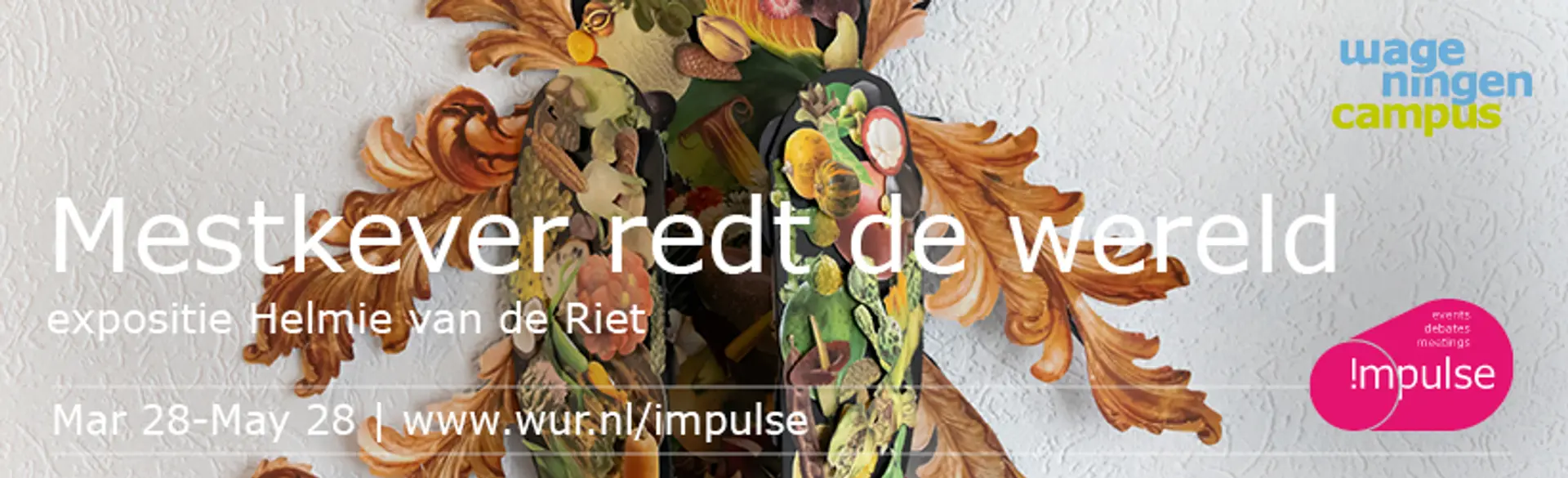
Exhibition: The Dung Beetle Saves The World
In the visual art of Helmie van de Riet, the dung beetle takes center stage as a symbol of meaning. This seemingly unremarkable creature serves as the starting point for a multi-layered and exploratory body of work that brings together care, responsibility, and ecological awareness. The choice of the dung beetle was inspired by scientific research from Wageningen University, which revealed that dung beetles orient themselves by the Milky Way when rolling their dung balls to maintain a straight path.
This fact intrigued Helmie: an animal that lives on and beneath the ground, yet determines its direction using the star system. All that space “in between” forms the core of Van de Riet’s visual research. In that space, science, imagination, and symbolism converge.
Within the work, the dung beetle is given an almost human status. The animal is endowed with its own wardrobe, a family crest, and a family tree in which both the male and female lines are visible. Thus, the dung beetle appears not only as a functional part of the ecosystem, but also as an individual with a history, identity, and role.
The dung beetle serves as a symbol of care and responsibility. While we humans often fall short in caring for our planet, this small animal ceaselessly fulfills an essential role in cleaning up, maintaining, and fertilizing its environment—without ever being squeamish about it. The work emphasizes that caring for the earth does not depend on size or power, but on simple, purposeful actions.
The exhibition invites us to reconsider what is valuable: the power of the small and the role that every creature, large and small, can play within the larger ecological whole.
Exhibition & lecture
In this exhibition, on view from March 30 through the end of May, the dung beetle appears as an alter ego: a small creature that tirelessly contributes to restoration and ecological balance. Scientific research and artistic imagination merge in a reflection on caring for the Earth.
Please also be invited for the lecture on May 12 at Impulse.