
Wageningen Campus logo

Nieuwe generatie bedrijven maakt vlees zonder dieren en vis zonder visvangst

Vlees zonder dieren, melk zonder koeien en vis zonder visvangst: WUR-onderzoekers en aan WUR gelieerde bedrijven werken er aan. Ze noemen het cellulaire landbouw of precisie-fermentatie. Op 28 november bespraken de ontwikkelaars de voortgang in een workshop op Wageningen Campus.

‘Produceer vlees zonder dieren’. Dat is vrij vertaald de slogan van het bedrijf RespectFarms, dat dierlijke cellen in een bioreactor produceert. ‘Maar dit is geen voedsel uit het lab dat we willen produceren in grote fabrieken’, zegt Ralf Becks van RespectFarms, beducht voor de lage maatschappelijke appreciatie van kweekvlees. ‘In onze filosofie werken we samen met boeren en gaan boeren in de toekomst zowel koeien houden als vlees produceren in een bioreactor.’

Milieuvriendelijke bioreactor

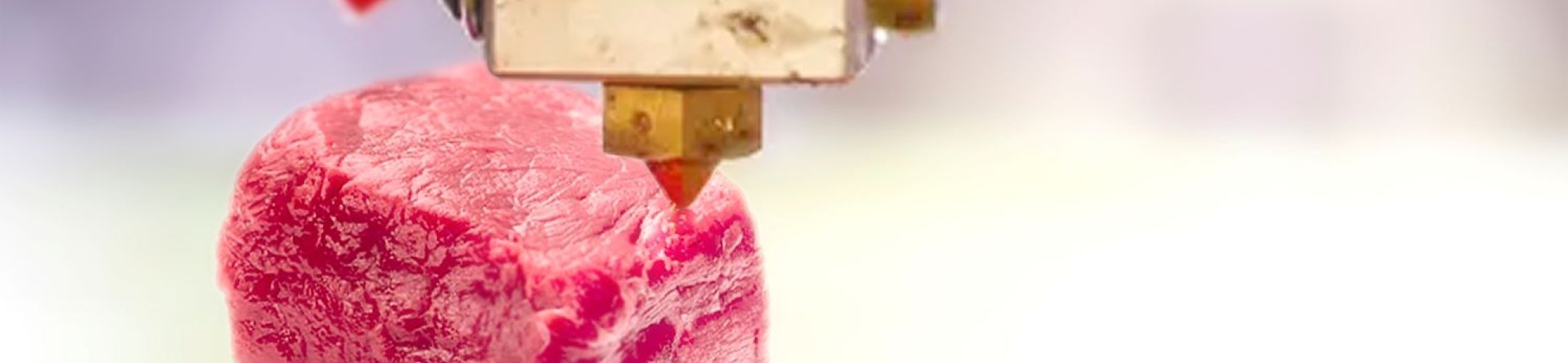
RESPECTfarms, opgericht in 2022, kweekt spierweefsel in een bioreactor met behulp van stamcellen van koeien en plantaardig voer. Het spierweefsel wordt met behulp van een 3d-printer verwerkt tot stukken vlees. Het bedrijf heeft de kweek van dierlijke cellen onder de knie en zoekt nu financiers en boeren die willen deelnemen. ‘We hebben het liefste een demofabriek nabij Wageningen’, zegt Becks, die mikt op een faciliteit die 100 ton vlees per jaar produceert.

Het kweekvlees van Respectfarms is veel milieuvriendelijk dan gangbaar vlees, blijkt uit onderzoek van WUR in opdracht van RespectFarms. De bioreactor vergt 95% minder land, 78% minder water, 93% minder milieuvervuiling, 92% minder broeikasgassen en 56% minder maatschappelijke kosten dan de koe in de wei. Met dit procedé kan de wereld de groeiende vraag naar vlees realiseren en toch de klimaatdoelen halen, stelt Becks. De komende jaren moet het bedrijf nog wel twee hordes nemen: de wetgeving voor kweekvlees in de EU is nog niet rond en er liggen nog vragen hoe de productie kan worden opgeschaald om de kosten te drukken en het kweekvlees concurrerend te maken.

Stamcellen die vetzuren maken
This method is suited for more than just replicating meat. It can also be used for fish. Upstream Foods, founded in 2022, grows fish cells. Mainly fat cells, as this is what causes the typical fishy flavour. Like RespectFarms, Upstream Foods uses stem cells. These cells are unspecialised and can reproduce and specialise into muscle or fat cells. The company currently has forty cell lines of salmon and trout but is still at the lab-culturing stage, says founder Kianti Figler during the workshop on Wageningen Campus.

Many consumers have given meat substitutes a go but often dislike the flavour of plant-based alternatives, says Figler. Animal fats largely determine the flavour. Hence, the start-up is working on stem cells capable of producing fatty acids in a bioreactor. She hopes to start a pilot factory within several years.

Cellular agriculture

Most cellular agriculture has yet to leave the laboratory. This also applies to the production of lactoprotein without cows. Wageningen researcher Etske Bijl works on precision fermentation within an NWO (Dutch Research Council) project. This process produces lactoprotein, called caseins, from micro-organisms. The goal is to produce cheese and yoghurt from these proteins without the help of a cow.

So far, vegan milk is not terribly successful, Bijl explains. This is due to the fact that plant-based proteins are not very suited to replace animal proteins as plant proteins are relatively small, while caseins are very big with a protein structure that stores minerals such as calcium. This makes Bijl’s casein structures a better alternative to cow milk than plant-based milk. She has already produced a mozzarella cheese using her proteins, albeit just a few milligrams. Here, too, upscaling is required.

Palm oil without palm

Cellular agriculture is still under development, but some businesses have already moved along. NoPalm Ingredients, for example, was founded in 2021 to produce palm oil without palm trees. The business is now able to manufacture palm oil from food waste using yeast. According to co-founder and researcher Jeroen Hugenholtz of NoPalm Ingredients, this process is successful, and the product can compete with regular palm oil. The big question is whether production can be scaled up to an industrial level.

Hugenholtz is working on realising a testing factory capable of producing 100,000 litres of oil. That is the scale required to play a role within the food chains. Such a facility needs machines to extract and purify oil at an unprecedented scale. Moreover, there are no facilities available in Europe that are capable of taking all the steps in the production process at this scale. Hence, Hugenholtz is currently conducting tests at various locations in the Netherlands, Germany, France and England to test large-scale production. ‘Very expensive and difficult to plan’, Hugenholtz clarified during the workshop on cellular agriculture on Wageningen Campus.

Share:
Nieuwe generatie bedrijven maakt vlees zonder dieren en vis zonder visvangst | Wageningen Campus