
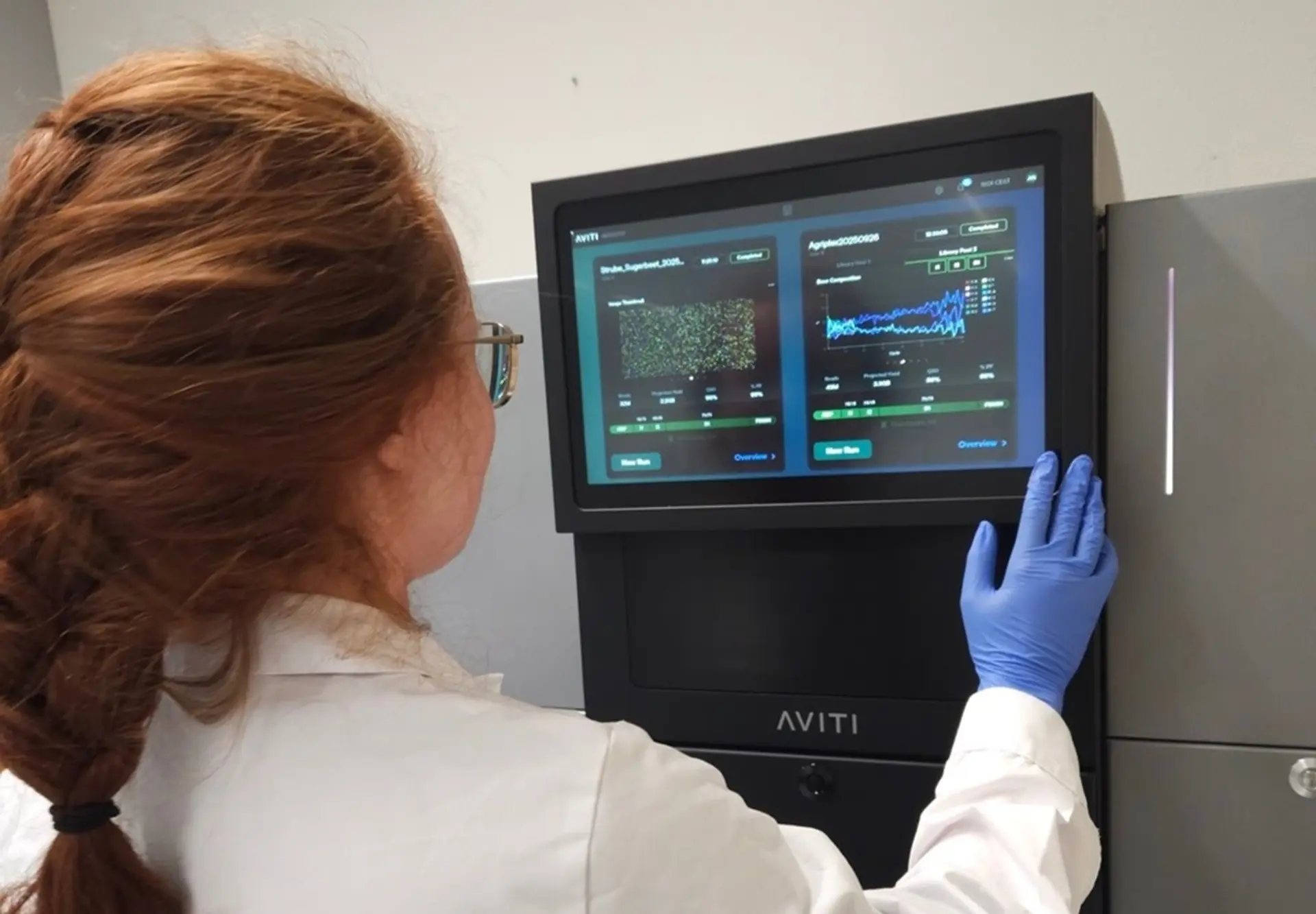
Image: A researcher working with the Aviti sequencer. Source: VHLGenetics.
VHLGenetics invests in Aviti sequencer with guaranteed shared use
VHLGenetics invested in an advanced Aviti sequencer in autumn 2025, while WUR-Bioscience guarantees a minimum number of runs per year. The team coordinating the Shared Research Facilities (SRF) at WUR brought the parties together. According to business developer Kitty Huijben and researcher Elio Schijlen, the collaboration opens up new opportunities for both sides.
VHLGenetics, based at Wageningen Campus West, has grown over the past 40 years into a major player in non-human genomics. The company carries out a wide range of DNA tests to map the genetic profiles of livestock, companion animals and plants. “For example, we work with breeders who want to know whether their animals are carriers of hereditary diseases, and with plant breeders seeking to identify genetic variants in new varieties,” explains Kitty Huijben, business developer at VHLGenetics.
The company distinguishes itself through tailor-made solutions and advanced technology. “Recently, we’ve seen an increase in requests that challenged us to expand our capabilities,” says Huijben. “Clients were asking for deeper genetic insights or to perform targeted sequencing.” Targeted sequencing focuses solely on specific sections of DNA that encode for a particular variant or feature.”
For VHLGenetics, these new customer demands prompted the search for a sequencer with broader capabilities: the Aviti, a next-generation short-read sequencer.
Short read or long read?
Short read sequencing analyses billions of small DNA fragments simultaneously at high speed, ideal for large-scale applications such as comparing genomes or detecting genetic variants. Long read sequencing reads much longer stretches of DNA in a single pass, which is particularly useful for analysing complex genomic structures and therefore suited to different applications.
Elio Schijlen is a scientific researcher and project leader at WUR-Bioscience. This division of Wageningen University & Research (WUR) houses various ‘omics’ facilities, for metabolomics, proteomics and genomics analyses, which are widely used for both scientific and applied research. “The Aviti is an excellent successor to the Illumina technology we have worked with for decades: flexible, cost-efficient and clearly higher in data quality than its predecessors,” he says. The instrument can be used for whole genome sequencing, single-cell analysis, targeted sequencing and RNA sequencing, and features independent flow cells that allow two runs to operate simultaneously.
A connecting link
The Aviti sequencer is a remarkable piece of equipment, but commanding a substantial investment. With such a major investment, overcapacity is a genuine risk. “With only one user, it is difficult to utilise the instrument efficiently and earn back the investment,” Schijlen explains. Moreover, the technology is evolving at great speed. “When purchasing the Aviti, collaboration was therefore not a luxury but a necessity,” Huijben adds. In discussions with the team coordinating the shared research facilities at WUR, with whom VHLGenetics had an established relationship, it became clear that WUR-Bioscience was interested in both the technology and a partnership.
Initially, WUR-Bioscience was to purchase the Aviti, with VHLGenetics joining as a user. However, following reductions in research funding, the arrangement was reversed: VHLGenetics purchased the instrument, with WUR providing a usage guarantee. “The contracts were drawn up quickly,” says Schijlen, “in part because the shared research facilities support team has facilitated similar collaborations before and had the templates ready.”
Five minutes by bike
The instrument has been installed in the VHLGenetics laboratory at Wageningen Campus West since September 2025, and the collaboration has been running remarkably smoothly. WUR researchers simply send an email when their samples are ready for a sequencing run and cycle over to VHLGenetics. “It’s a five-minute bike ride and you’re there,” Schijlen says.
This proximity offers additional advantages. Huijben explains: “Clients prefer to keep the data local, not just to avoid longer turnaround times, but also to ensure confidentiality,” Huijben explains. Given current global political developments, confidentiality is becoming increasingly important.”
Staff from both organisations attended joint training sessions. VHLGenetics operates the sequencer itself, while WUR provides input for unusual samples or when data analysis requires additional expertise. “We have many years of experience in bioinformatics and data infrastructure, expertise that VHLGenetics cannot build up overnight,” Schijlen notes.
New clients, new projects
Thanks to the Aviti, Schijlen has already been able to save considerable time. He is working on single-cell genomics projects involving the sequencing of individual plant cells. “These are fragile samples that cannot be stored for long. With the Aviti just nearby, you know within two to three days whether a protocol works.”
For VHLGenetics, the instrument is opening doors to new markets. Huijben explains: “A client who had been commissioning standard genotyping projects from us for years immediately requested a pilot project when we explained that we could also study the genetic variation within his population. We are now having these kinds of conversations regularly.”
To raise awareness of the enhanced services they can now offer, VHLGenetics and WUR are organising a seminar on 10 March together with supplier Element Biosciences, focusing on the Aviti.
Go for it
Schijlen and Huijben are united in their advice: if you are considering a joint investment, simply go for it. “In a collaboration like ours, entrepreneurship and research go hand in hand, and that leads to inspiring new ideas,” Schijlen says. Mutual trust is essential, Huijben emphasises. “Allowing someone into your laboratory or onto your instrument, requires clear agreements and mutual trust.”
The two are already cautiously contemplating a next step: WUR potentially acquiring a long read sequencer that could also be made available to VHLGenetics. Huijben concludes: “We now know what we can expect from one another. That makes it easy to look ahead together.”
In the period 2026 to 2029, another 1M€ subsidy per year has been made available by the Province of Gelderland and RegioDeal Foodvalley for the purchase of shared innovative research equipment. Want to know more? Please contact the Shared Research Facilities team via sharedresearchfacilities@wur.nl for information about the possibilities and the conditions.
To raise awareness of the enhanced services they can now offer, VHLGenetics and WUR are organising a seminar on 10 March together with supplier Element Biosciences, focusing on the Aviti.
More information:
Genomics Facility - Long-read and short read DNA sequencing | WUR